Most homeowners who reach us have already made the hard decision. They know they need a repipe. What they’re stuck on is the material sitting inside their walls for the next few decades. That’s the right question to sweat, and it’s also where most of the internet gets it wrong, because a material chart written for the whole country doesn’t know a thing about the water running through your house here in Metro Atlanta.
We’re Plumbing Express, a dedicated repipe specialist serving Metro Atlanta since 1989, with 180+ whole-house repipes completed across the metro in the past year alone and thousands of homes repiped over the life of the company. We install PEX-A, PEX-B, and FlowGuard Gold CPVC every week. So this isn’t a theory piece. This is what we actually reach for on the truck, and why, once we’ve looked at your home and your water.
Why Atlanta’s water beats any material chart
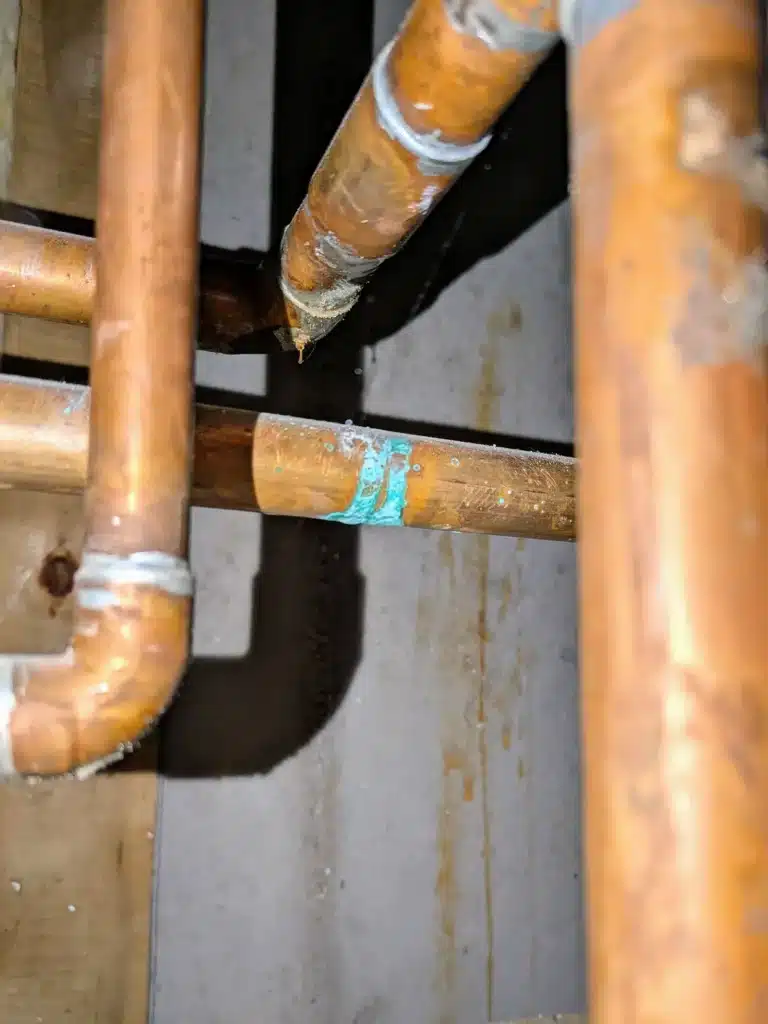
Here’s the thing a generic comparison can’t tell you. The material that fails is often the material the chart calls “the gold standard.” Copper is a beautiful pipe. It’s also the material we see develop pinhole leaks in Metro Atlanta homes with maddening regularity, especially in older-copper neighborhoods.
Researchers still debate exactly what causes copper pipe to develop pinhole leaks. What is not debated is the pattern we see in the field: pinhole leaks cluster by water system, strongest in homes served by Cobb County Water System and neighboring city utilities, and nearby homes tend to fail on similar timelines. The water meets all federal safety standards. The concern is pipe longevity, not drinking water safety.
A brown ring shows up on a ceiling two doors down
One house. Nobody thinks much of it.
The neighborhood thread starts
Two more homes on the same street post about water stains and rising bills.
Three repipes on one street in a month
Same build year, same copper, same water system. The pattern is no longer a coincidence.
You find your first pinhole
Your pipe is the same age, in the same wall, carrying the same water.
Your repipe, in 2 to 5 working days
New lines to every fixture, tested before the water comes back on, and the walls put back by our own drywall and paint crew.
Illustrative of the pattern we see, not a specific address. In a planned subdivision, homes share a build era and often the same pipe, and failures cluster. Strongest in homes served by Cobb County Water System and neighboring city utilities — the water meets all federal safety standards; the concern is pipe longevity.
We’ve watched that pattern hold for years across Marietta, Smyrna, Austell, and Powder Springs, plus homes in Cherokee and Gwinnett counties. It’s why we don’t lead with a national spec sheet. You don’t need to win the chemistry debate to read the pattern. So when someone asks us “which material lasts longest,” the honest answer starts with “where do you live and what’s your pipe doing now,” not with a durability column on a table.
The four materials, plainly
PEX-A is the most flexible of the bunch. It’s a cross-linked polyethylene tube that we join with expansion (press-style) fittings that hold the pipe’s full inner diameter open at every connection. That flexibility means fewer joints, and joints are where systems fail. PEX is now the fastest-growing part of our repipe business, and for good reason.
PEX-B is the same family, cross-linked by a different method, a little stiffer, and every bit as capable inside a wall. We install Viega PureFlow PEX-B and back it with a 25-year manufacturer materials warranty.
CPVC (we install FlowGuard Gold) is a rigid plastic joined with solvent-weld cement. It’s a proven supply material with a long track record and a 30-year manufacturer materials warranty behind FlowGuard Gold. It has real merits and we sell it on those merits.
Copper is the rigid metal pipe most 70s-through-90s Atlanta homes were plumbed with. We’ll install it on request, and it carries our workmanship warranty like anything else, but given the local pinhole pattern it is not a material we push for new installs.
A note on flow, since it gets misrepresented
One thing we won’t do is oversell PEX with a flow-rate story. PEX actually flows less than CPVC. Our fittings advantage is real, but it’s a PEX-versus-PEX advantage. Our premium expansion fittings keep the full inner diameter open, where older crimp fittings pinch flow at every joint, most noticeable at fixtures on longer runs like a master bath or a basement. If a contractor tells you PEX moves “70% more water” than CPVC, that number isn’t real.
Installation, cost, and lifespan compared
Flexibility
How far the pipe bends around framing. More bend means fewer joints, and joints are where systems fail.
Best here: PEX-A. Fewer connections sitting inside your walls.
Joining method
How each length of pipe connects to the next. It’s the detail that decides how much water reaches your shower.
What it means for you: expansion fittings hold the pipe’s full inner diameter open at every connection, where older crimp fittings pinch flow at every joint.
Manufacturer materials warranty
How long the company that made the pipe stands behind it. Separate from, and additive to, our 10-year workmanship warranty on the installation.
Longest here: FlowGuard Gold CPVC, at 30 years. Uponor’s warranty is transferable if you sell the home.
Freeze tolerance
What happens on a hard Atlanta freeze when a line in an exterior wall or crawlspace ices up.
Best here: PEX-A, because it expands instead of splitting. Freezing is not covered by any warranty, on any material.
Local pinhole risk
Whether we see this material fail from the inside out in Metro Atlanta water. This is the column a national chart can’t fill in for you.
Only copper carries this risk locally. It is the material we are most often replacing.
Installed by us
What we stock, install every week, and warranty as our own work.
We’ll install copper if you ask for it. Given the local pinhole pattern, it isn’t what we push for new installs.
Not sure which column describes your house?Four questions about your home, and we’ll tell you where we’d start.
On cost, the material itself is rarely what moves your number. What actually drives a repipe price is home size and fixture count, number of stories (vertical runs cost more than a single-level ranch), foundation type (a slab needs more cuts than a crawlspace or basement), and the drywall and paint restoration scope. Most Metro Atlanta homes we repipe land in the $10,800 to $14,100 range.
Home size and fixture count
Every fixture is a run of new hot and cold line. More fixtures, more pipe, more hours.
Number of stories
Vertical runs cost more than a single-level ranch.
Foundation type
A slab needs more cuts than a crawlspace or basement.
Restoration scope
The drywall and paint work needed to put the walls back, done by our own technicians.
Where most Metro Atlanta homes land
Some cost a little less, some quite a bit more. The material itself is rarely what moves your number, and the only way to get an exact one is a free in-home visit.
“Most homes run $10,800 to $14,100. That’s the range where the majority land, not the floor or the ceiling.”
Ty Gailey, owner
Some cost a little less, some quite a bit more, and the only way to get an exact number is a free in-home visit.
Lifespan is where the local reality matters most. On paper copper lasts generations. In practice, in the neighborhoods we work, copper is the material we’re most often replacing. The plastics don’t share that failure pattern here.
Want your number instead of a range?Tell us about your home and we’ll bring a fixed-price quote to the free in-home visit.
PEX failure windows worth knowing
Not all PEX is a problem. Most of it performs well. But certain earlier generations of PEX have a documented failure history, and it comes in two separate windows.
1995–2010
no documented pattern
2015–2022
reformulated PEX
These were design and formulation-era runs, several of them subject to class-action litigation. You identify them by the code printed on the pipe, cross-referenced against the lawsuit list, and you watch for yellowing or micro-cracking.
These were defective lots supplied to national production builders under exclusivity deals, which means whole subdivisions built by one builder in that window can share the same bad PEX. We’ve seen entire developments plumbed with a single problem lot.
Hatched stretches are the periods with no documented pattern. If your home was built inside a red band, the code printed on the pipe tells us which generation you have. The defect belongs to a product generation, never to a whole brand.
That’s why “my house is newer, so I’m fine” doesn’t always hold. Newer just narrows down the likely material. Real risk is about which manufacturer and which builder era. The reformulated PEX products on the market today are a different story, and the defect belongs to a product generation, never to a whole brand.
Warranty coverage by material, without the fine print
Some homeowners assume “10-year warranty” covers everything in the wall, and it doesn’t. Here’s exactly how ours works.
Plus 1 year on fittings, valves, and fixture supply lines. Warranty visits carry no diagnostic fee.
Every Plumbing Express repipe is covered in two layers. Our workmanship warranty backs the installation with a 10-year workmanship warranty on the pipe, plus 1 year on fittings, valves, and fixture supply lines. If anything about our installation does not hold up, we make it right, and warranty visits carry no diagnostic fee.
The manufacturer’s materials warranty is separate and additive. The pipe itself is backed by the company that made it: 25 years on Uponor PEX-A, 25 years on Viega PureFlow PEX-B, and 30 years on FlowGuard Gold CPVC, which our installs carry because Plumbing Express is a registered FlowGuard Gold contractor with Lubrizol.
Uponor’s warranty is transferable if you sell your home, and transferability terms for each material appear on your written proposal.
Which warranty would your repipe carry?The answer follows the material. Four questions and we’ll tell you which one we’d put in your walls.
Covered
- Our installation workmanship, 10 years on the pipe
- Fittings, valves, and fixture supply lines, 1 year
- The pipe itself, by its manufacturer: 25 / 25 / 30 years
- Warranty visits, with no diagnostic fee
Not covered
- Freezing
- Corrosion
- Normal wear and tear
- Damage from work done by others after we finish
- Consumable parts like washers and aerators
Full terms are stated in your signed proposal.
What the repipe itself actually involves
The material is the part people worry about least once we explain the work. A repipe replaces your entire water distribution system, up to every fixture in the home. That means new hot and cold lines serving your showers, sinks, toilets, washing machine, icemaker, and every other water connection, plus new valves, hose bibbs, the PRV, and the expansion tank.
Before a single cut is made.
Set aside, not destroyed. It goes back at the end.
Hot and cold, to every fixture in the house.
Plus new valves, hose bibbs, the PRV, and the expansion tank.
Water’s back every evening.
Same job scope as the pipe crew. No second contractor to chase.
For island sinks on a slab foundation we have an alternative connection method that doesn’t always require breaking the slab.
On the day, we put protective plastic on walls and furniture, cover wood floors, make strategic cuts in walls and ceilings for access, set the drywall aside, run the new lines, connect hot and cold to every fixture and shower valve, then test the whole system before your water comes back on. For island sinks on a slab foundation we have an alternative connection method that doesn’t always require breaking the slab.
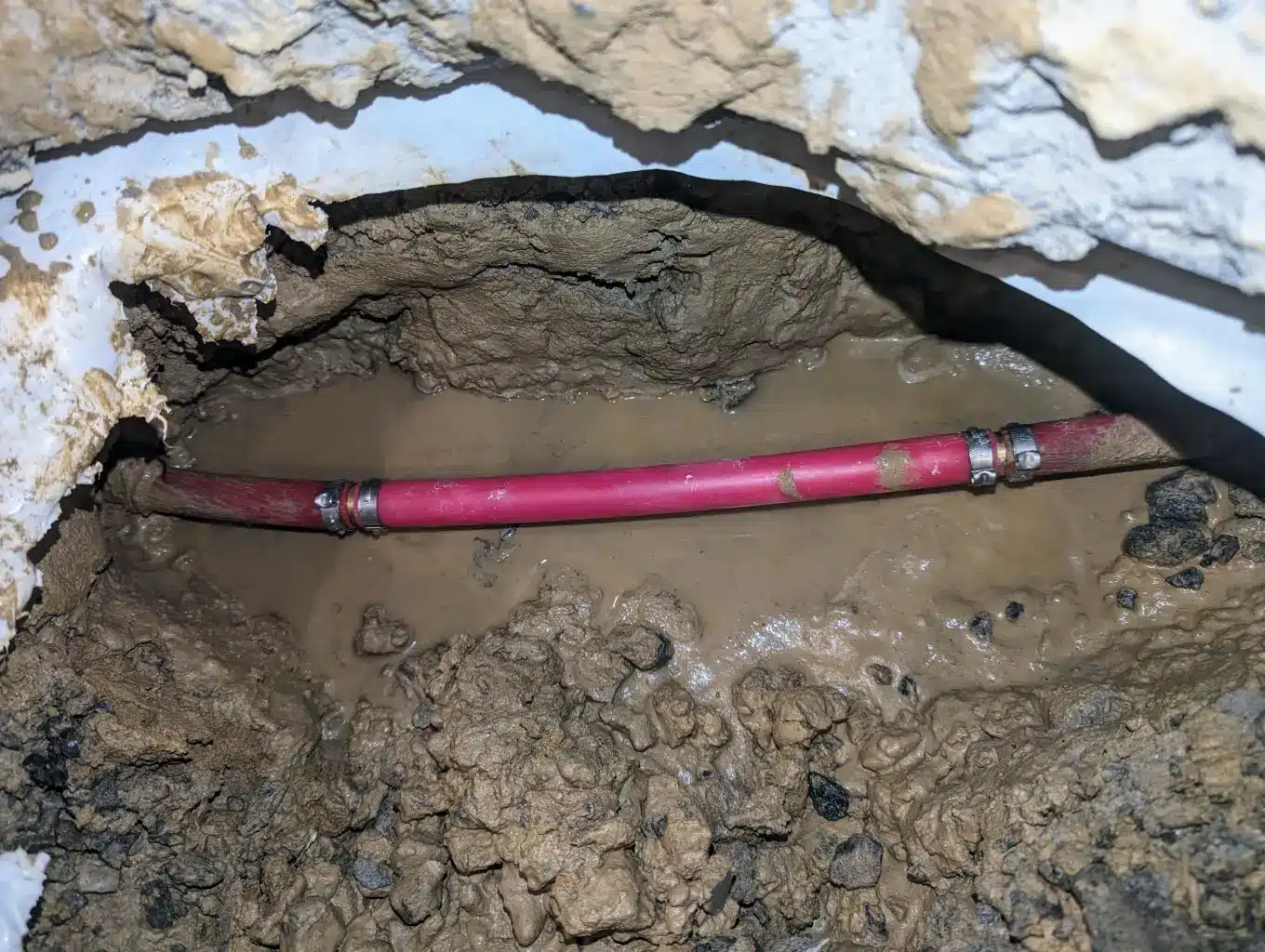
The finish is where we’re different. We use dedicated in-house drywall and paint technicians working from the same job scope as the pipe crew, so there’s no second contractor to chase and no waiting on someone else’s calendar. Like a lot of our customers tell us, “you can’t find where the work was done.”
Our service area
We repipe across Metro Atlanta from our base off Presidential Drive, with heavy volume in the Cobb County corridor: Marietta, Smyrna, Austell, and Powder Springs, plus Cherokee and Gwinnett counties. If you’ve heard a neighbor got repiped, or your HOA or a neighborhood Facebook group is talking about pipes, that’s not a coincidence. In a planned subdivision, homes share a build era and often the same pipe, and failures cluster.
Don’t see your service? Call us today to find outA real person answers, 24/7.
Which material fits your home?
Four questions, then a starting recommendation. The real answer still comes from looking at your home and your water, which is what the free in-home visit is for.
Start with your home
This narrows the field. It doesn’t replace a look at your existing pipe and your water service line.
Frequently asked questions
Why is CPVC no longer used in some homes?
CPVC is still very much a current, code-approved supply material, and we install FlowGuard Gold CPVC on repipes today. Its rigidity means more fittings and a solvent-weld joint at each one, so some installers prefer the flexibility of PEX, but that’s a preference, not a defect. FlowGuard Gold carries a 30-year manufacturer materials warranty, which tells you how the maker rates its longevity.
Why don’t insurance companies like PEX plumbing?
The hesitation traces back to certain earlier generations of PEX that had documented failures, not to PEX as a category. Most PEX performs well, and it’s the fastest-growing part of our repipe work. The failures cluster in two windows (roughly 1995 to 2010 and 2015 to 2022), and the pipe code tells you which generation you have, which is exactly why we read the code rather than judging PEX as a whole.
Why use CPVC instead of PEX?
Some homeowners choose CPVC for its rigidity, its long proven track record, and its slightly higher flow than PEX. We sell CPVC on its own merits and won’t pretend one material wins every situation. The right pick depends on your home’s layout, run lengths, and what we find on the free in-home visit.
How many years will CPVC last?
FlowGuard Gold CPVC carries a 30-year manufacturer materials warranty, and installed correctly it’s built to serve well beyond that. Keep the two warranty layers straight: that 30-year figure belongs to the material’s manufacturer, while our own workmanship warranty on the installation is 10 years on the pipe plus 1 year on fittings and valves.
Which material should I choose for my Atlanta repipe?
For most Metro Atlanta homes we recommend PEX-A or a quality PEX-B, with FlowGuard Gold CPVC as a strong alternative, and copper only when a homeowner specifically requests it.
Given the local pinhole pattern in copper, the plastics are usually the smarter long-term call here, but the real answer comes from looking at your home and your water first.
Get your number and your material recommendation
Most people who call us already know they want a repipe. They want a number and a plan, not a lecture, so that’s what we give you. We’ll come out for a free in-home estimate, look at your existing pipe and your water service line, recommend the right material for your home, and hand you a fixed-price quote where the number on the estimate is the number on the invoice.
Water’s back every evening, the job runs 2 to 5 working days, and there’s no pressure to move forward until you’re ready. Plumbing Express is a licensed and insured Georgia plumbing contractor, with 2,000+ reviews and a 4.9 average across Metro Atlanta. Call us or request your free in-home estimate to start the quote process.