Most people have no idea what’s running behind their walls until a leak forces the question. That’s normal. But if you own a home anywhere in Metro Atlanta, knowing what your supply lines are actually made of tells you a lot about what to watch for and whether you’re sitting on a problem that gets worse on its own. We’ve done 180+ whole-house repipes across Metro Atlanta this past year alone, and the pipe material is almost always the first thing we identify on a visit.
Here’s how to figure out what kind of pipes your house has, decade by decade, and which materials give homeowners the most trouble around here.
How do I find out what kind of pipes my house has?
The fastest way to tell what kind of pipes your house has is to look at the exposed sections where the plumbing is visible: under sinks, at the water heater, and along the ceiling or joists of a basement or crawlspace. That’s where the pipe is out in the open and you can actually read it.
Grab a flashlight and check three spots. First, the shutoff valves and short lines under a bathroom or kitchen sink. Second, the pipes feeding your water heater. Third, wherever supply lines run across an unfinished basement ceiling or through a crawlspace. Most homes use one dominant material for the whole supply system, so what you find in one clear spot usually tells the story for the rest of the house.
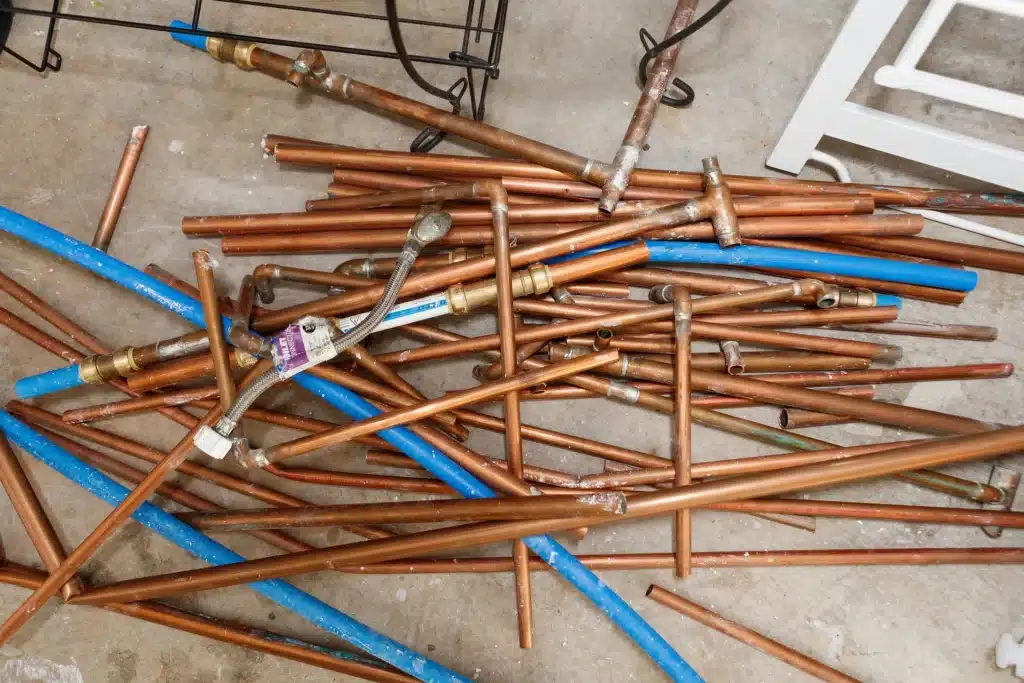
Color and feel are your quick tells. Copper is a dull reddish-brown, sometimes with green or blue spots where it’s aged. Plastic tubing that flexes and bends is usually PEX. Rigid off white plastic with printing on it is often CPVC. And a dull gray plastic that looks a bit like old garden hose fittings, roughly half-inch to one-inch, is the one you really want to identify: polybutylene.
The decade-by-decade breakdown for Atlanta homes
Atlanta’s housing stock spreads across a lot of build eras, and each one leans toward certain materials. Use this as a starting guess, then confirm with your eyes. One important caveat up front: age is not a reliable predictor of whether you’ll need new pipes. We’ve repiped homes that were only 5 and 10 years old. What matters more is the piping material and, around here, how the sanitizing chemicals in the water interact with those pipes over time.
Homes built before the late 1970s
Older Atlanta homes often ran copper, and some very old ones had galvanized steel, though galvanized is rare in the homes we service now. Copper from this era can be perfectly fine or it can be showing its age. What you’re looking for is copper pipes and pitting corrosion: small dark pits or green and blue discoloration on the outside of the pipe. Those pits are where pinhole leaks start.
Homes built late 1970s through mid-1990s
This is the window that produces the most repipe calls we get. Two materials dominate: aging copper and polybutylene. Polybutylene is a dull gray, flexible pipe, usually half-inch to one-inch, and you can often confirm it by the ‘PB2110’ or ‘Qest’ stamp printed on the pipe. It was installed heavily during these years because it was cheap and fast to run.
The trouble is the plastic reacts with the chlorine and chloramine in municipal water and breaks down from the inside out, so it can look perfectly fine on the outside while it’s failing internally.
There’s no visible warning until water is already behind the drywall. If your home falls in this era, checking your supply lines before a leak decides for you is a smart move. If you find it, our guide on how to identify polybutylene walks through exactly what it looks like.
Homes built mid-1990s through today
Newer Metro Atlanta homes mostly use PEX (flexible plastic tubing) and sometimes CPVC. CPVC is a rigid, cream or light-yellow pipe with printing along it; the premium version we install, FlowGuard Gold, carries its name right on the pipe. PEX is a good material overall, but not every system holds up the same way, and failing PEX is the fastest-growing source of the repipes we do. Polybutylene and aging copper still account for more of our calls today, but PEX is climbing fastest. Two failure patterns show up: PEX-B joined with crimp fittings, where the fittings pinch and stress each connection, and, increasingly, the pipe itself breaking down from the water running through it. If your home has PEX, watch for yellowing or fine micro-cracking on the tubing and any staining or moisture near fittings. Our PEX pipe failure page covers the warning signs, and if the tubing is behind drywall we can identify what you have on a free in-home visit.
Why we’re starting to see PEX-A fail, too
For years the assumption was that premium PEX-A would easily outlast the cheaper crimp-fitted systems. Lately we’re seeing PEX-A fail early as well, and the cause usually isn’t the pipe. It’s the water. Every grade of PEX depends on a built-in antioxidant package to protect the plastic, and that protection gets used up over time.
Aggressive disinfectants burn through it much faster. The biggest culprit is chlorine dioxide, a treatment more and more utilities have adopted to meet tighter federal rules on bacteria. It attacks PEX at the molecular level from the inside, and it can take a system that should last decades down to just a few years. Industry testing has shown PEX exposed to chlorine dioxide failing within 2 to 3 years of install. That’s why we don’t treat PEX-A as an automatic choice. On the free in-home visit we look at your pipe and your water together, and where the chemistry is aggressive we’ll often recommend FlowGuard Gold CPVC, which resists chlorine, chloramine, and chlorine dioxide alike.
How do I tell if I have PEX or PVC?
PEX is flexible tubing you can bend by hand, usually colored red, blue, or white, while PVC and CPVC are rigid plastic pipe that won’t flex. That flex test is the quickest way to separate them.
PVC is typically white and used more for drain and waste lines than for pressurized supply.
CPVC, the one you’ll see on supply lines, is often a cream or light-gray rigid pipe with printing along it, and FlowGuard Gold CPVC (a premium version we install) carries its name right on the pipe. If it snaps rigid and reads CPVC, that’s what you’ve got. If it coils and bends, it’s PEX.
How to identify PEX pipe, and does my house have PEX A or PEX B?
You identify PEX by its flexibility and the printing stamped along the tubing, which lists the manufacturer, the standard, and often the type (PEX-A, PEX-B, or PEX-C) right there on the pipe. Read the print and you’ll usually have your answer in seconds.
We install both PEX-A and PEX-B, and each has its place. PEX-A is our premium option. It expands and recovers, which lets us use expansion-style fittings that keep the pipe’s full inner diameter open at every joint, and it’s the more forgiving pipe to route through a home. It also costs more. PEX-B is the more budget-friendly choice and a proven performer, joined with press fittings that make strong, reliable connections. Both are legitimate systems we stand behind. When homeowners ask which we’d run, we walk them through the trade-offs on the free in-home visit and match the pipe to the home and the budget. If you can’t read the stamp because the tubing is behind drywall, we can identify it on that same visit.
Are new homes using PEX or copper?
New homes today overwhelmingly use PEX, not copper. Copper still gets installed occasionally, but between its cost and the rise of PEX and CPVC, it’s simply not the popular choice for new supply work anymore.
We still install every one of these materials, and our 10-year workmanship warranty covers copper, PEX-A, PEX-B, and FlowGuard Gold CPVC alike. But when homeowners ask us what we’d run in their walls, it’s almost always premium PEX-A or FlowGuard Gold CPVC.
Why the Cobb County water angle matters for copper
We’re not here to scare anyone about their water, but we’ll be honest about what we see. A large share of the whole-house repipes we do are in homes on the Cobb County water system, especially the older-copper neighborhoods of Marietta, Smyrna, Austell, and Powder Springs. It’s a pattern we’ve watched hold for years.
If your home has copper and you’re in that corridor, keeping an eye on those exposed sections is worth the two minutes it takes. Pitting shows up first on the horizontal pipes on the lowest level of the house (basement or crawlspace), then eventually in ceilings and walls. A pit becomes a weep, a weep becomes a drip, and a drip becomes a fine spray and then a steady stream. Catching it while it’s still just a pit is the whole game. If you want the deeper explanation, we cover what causes pinhole leaks in copper plumbing in a separate post.
What identifying your pipes looks like on a real visit
Here’s a composite based on a pattern we see often, not one specific customer. A homeowner in a 1980s Marietta home had put off calling for months because they dreaded the walls being cut open. They’d already paid for two separate pinhole leak repairs in a single year, one in a bathroom wall and one in the basement ceiling, and a musty smell had crept in. On the free in-home visit, the estimator found early pitting corrosion in several other exposed copper sections. Rather than keep paying for one-off patches, they chose a whole-house repipe. The job ran three days, the drywall was numbered and stored by room, water was back on every evening, and the crew did a full walkthrough at the end. As one of our verified Yelp reviewers, Cindy A., put it: “Each sheetrock cut-out was numbered and neatly stacked for the next day. All pipes were replaced and water was back on by dinnertime that first day.”
That’s the reassuring part most people don’t expect. A whole-house repipe isn’t tearing your house apart. It’s installing a new water supply system, hot and cold lines run to every fixture as one connected system, tested before we finish. Most of the old line is simply abandoned in place. Because our drywall and paint restoration is done in-house, there’s no waiting on a second contractor to close things up.
Frequently asked questions
What’s the one pipe material I should worry about most?
Polybutylene is the material to worry about most, because it corrodes from the inside out and should be replaced whether it looks bad or not. It was installed widely in Atlanta homes built from the late 1970s through the mid-1990s, and a clean-looking gray line tells you nothing about its condition inside.
Does the pipe material affect what a repipe costs?
Yes, what’s being removed and replaced is one factor among several. Most Metro Atlanta whole-house repipes fall in the middle range of $10,800 to $14,100 (including sheetrock and paint matching), with home size, number of stories, and access all moving the number. As we tell everyone, the only way to get an exact figure is a free in-home visit, and the number on the estimate is the number on the invoice.
Is discolored water a sign my pipes need replacing?
No, rust-colored water and low pressure usually point somewhere else entirely, like your water main, water heater, or a single fixture, not a whole-house pipe failure. Discolored water often just follows a water-main repair. The real signals we act on are repeated leaks in different parts of the house within a year or two, and visible corrosion on the pipe itself.
What does the repipe warranty actually cover?
The 10-year workmanship warranty covers the installation of the pipe itself (copper, PEX-A, PEX-B, or FlowGuard Gold CPVC), while fittings, valves, and fixture supply lines carry a separate 1-year warranty. Some homeowners assume “10-year warranty” covers everything in the wall, and it doesn’t. On top of the workmanship warranty, manufacturer warranties are separate and additive: PEX-A carries 25 years and FlowGuard Gold CPVC carries 30 years.
Not sure what you’ve got? Let us take a look
Plumbing Express has served Metro Atlanta since 1989, and we’re a dedicated repipe specialist, not a general plumber who takes on a repipe now and then. If you’ve peeked under a sink and you’re still not sure what material you’re looking at (or you’ve spotted pitting, water spots, or you’ve had more than one repair in the same year), we’ll come identify it for you. Same-day in-home estimates most days, next-day at the latest, and no pressure to move forward until you’re ready. Call us at (404) 236-6535 or request a free repipe quote to get started.