


Warning Signs That Point to a Hidden Water Leak
A water bill that spikes without explanation
Damp or discolored patches on walls, ceilings, or floors
Warm or wet spots on the floor
The sound of running water when all fixtures are off
Low water pressure that developed gradually
A water meter that keeps running
Musty odors indoors
How Plumbing Express Locates Hidden Leaks in Metro Atlanta Homes
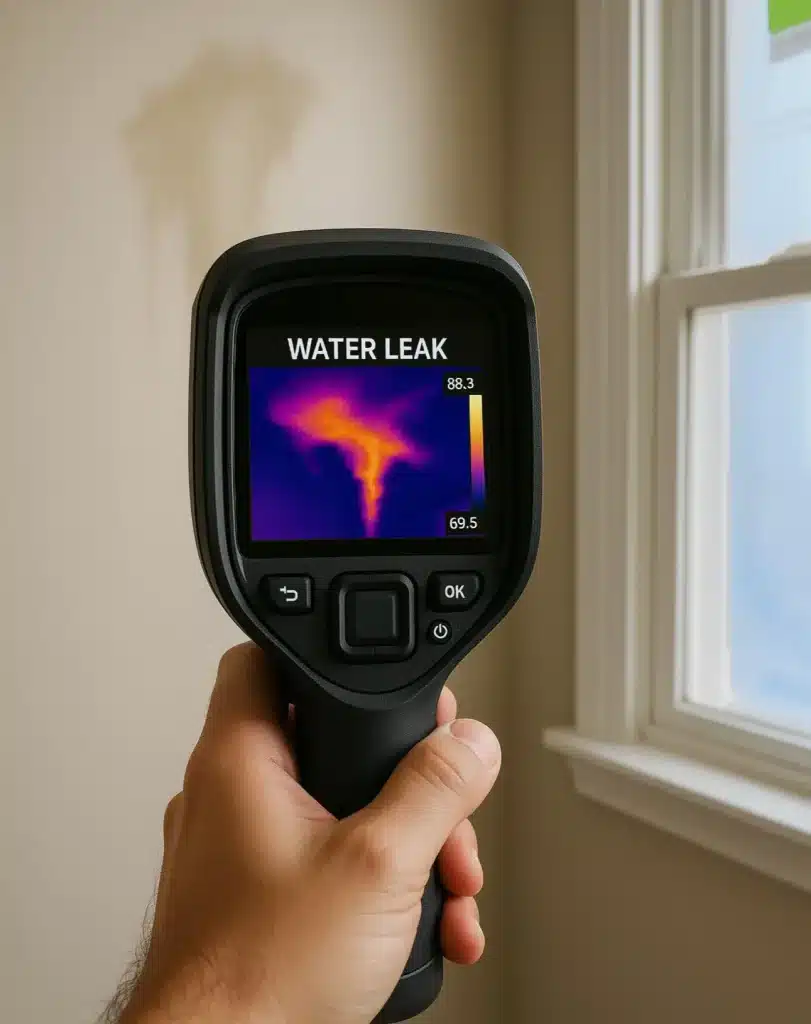
Thermal Imaging
Acoustic Detection
Trace Gas Testing
Types of Leaks We Detect and Repair
Slab Leaks, Yard Leaks, and Hidden Pipe Failures
Yard Leaks and Water Service Line Leaks
Meter Checks and Isolation Tests
These initial methods help determine if water is moving through your system when it shouldn’t be. Isolation tests are instrumental in identifying whether the leak is inside the house or in the external water service line.
The home is isolated from the main water service line to determine whether the leak is inside the house or in the yard. If the leak is outside, electronic line tracing and soil probing may be used.
Hot Water Leaks
Hot water leaks are often easier to detect because hot water causes noticeable temperature differences in floors and walls. If your water heater is constantly running, it may indicate a hot water leak.
Cold Water Leaks
These are harder to detect with thermal imaging since the water temperature is closer to the ambient temperature. Cold water leaks often require more traditional methods, such as moisture meters or sonar detection, to locate.
In-Wall and Ceiling Leaks
The Cost of Waiting: Why Hidden Leaks Get Worse
Structural damage
Mold growth
Wasted water
Higher repair costs
Why Plumbing Express
Honest Leak Diagnosis from Georgia Licensed Plumbers
You See the Diagnosis Before We Touch Anything
You Get Options, Not a Prescription
One Team, Start to Finish
Local Experience Since 1989




What Atlanta Homeowners Say About Plumbing Express
 Rating


Service couldn’t be completed due to needing a new system. We appreciate the very informative visit as well as insight that could help after a new unit install.

Plumbing Express was great. I had a failed sump pump that had partially overflowed into the basement. Nasty. Josh was the tech that did the work. He was efficient, neat and courteous. I will use Plumbing Express if I have any other plumbing needs and I will recommend them to my family and friends.


The technician was very knowledgeable and professional. I believe they did a very good job.

Ron was our second plumber from this company. The first plumber came, examined pipes and said he found no leak, even though we had experiences a large amount of water leaking from the ceiling in the finished basement. Several days later we had another leak-same area but less water the second time. Ron came in, listened to our frustration and did a more thorough inspection of the pipes and identified the problem. He was very personable and professional. On his third visit, we had several replacement pipes installed and are without leaks again. Our frustration, with the situation, was my son had used your company to replace pipes when he purchased the home and founding out not all the pipes were included with that process.


Tim arrived on time and was very professional. He took his time to explain the problem and the process it would take fix the water line.

Called Plumbing Express as tankless hot water not operating. Their website states "Get Free Plumbing Quote ". When service man showed up an looked at unit he said there would be a $207 charge to look into unit in order to give me a quote to fix unit. Due to not having hot water and time required to get another company to address the problem I agreed to pay $207 for quote. After looking in unit I was told he would not be able to fix due to age of unit and parts not available. I think he should have said parts not available when seeing model number on front of unit and I would not have wasted $207.

Outstanding customer service, we will definitely be using them in the future for any plumbing needs. Can’t thank them enough!

Extremely knowledgeable and very helpful. The team was excellent. The job was completed in 1 day with a great team. Very expressive.

Daniel Perez was great in coming out to check the problem I had with a water leak from my air conditioner line. His recommendation was correct.

Great and informative service while I was in a bind without a functioning water heater.

Plumbing Express is my go-to plumbing support team. They have fair pricing, well-vetted technicians, and a truly exceptional scheduling system. Rod, my technician, was the best. He quickly assessed the problem and gave a fair estimate, working hard to keep to the schedule. He even brought Josh along on the day of service, and the two of them worked well together. They addressed the bathtub drain repair with expertise and caused the least sheetrock damage. It was difficult to replace the broken pipe and get to the upstairs drain, but together they made it a success.

Daniel did a great job and was very professional during his service call last week!

Rod and Josh did an awesome job taking care of my clogged sinks. Knowledgable, professional and great to work with - I really appreciated their help today and would highly recommend them and Plumbing Express!

Daniel was excellent. The work he did was simply superb. I highly recommend your company and hopefully Daniel will get more and more work

Dylan from Plumbing Express came over and replaced our garbage disposal for us. It was older, had a massive leak, and needed to be replaced. He did a great job and was in and out in about 30 minutes! I also asked him to check out a potential leak I had been hearing in my ceiling. He used a thermal camera to investigate and was very honest and upfront about what he found. Rather than immediately cutting into the drywall to confirm something uncertain, he explained that the sound could simply be pipes expanding and that opening the wall might be unnecessary. He recommended monitoring the area and waiting to see if a wet spot appears, which would clearly indicate an actual leak. I really appreciated that he didn’t try to upsell or push unnecessary work. Overall, great service and a great guy. They will definitely be our go-to plumbing service from now on.


Once again we had some problems under our kitchen sink so we called Plumbing Express who were able to get us on their schedule pretty quickly after these storms Tim Robinson came out to do the job. Tim has been to our house for a number of different plumbing problems. He is personable & professional. As usual he did a great job even though this particular problem turned out to be far more difficult than anyone had expected. As frustrating as it was, Tim worked through it until he finished the job. We can't thank him enough.

Anthony was very competent, professional and friendly. He answered all my questions throughly. Highly recommend!
Frequently Asked Questions About Leak Detection
How do I know if I have a hidden leak?
Will you have to cut into my walls to find the leak?
What is the difference between a slab leak and a regular water leak?
How long does a leak detection visit take?
Can a small leak cause serious damage?
My home has copper pipes and I keep getting pinhole leaks. Is that normal?
My home has polybutylene pipes. Should I be worried about leaks?
Yes. Polybutylene is a known failure-prone material installed in many Metro Atlanta homes built between 1978 and 1995. If your home has gray plastic supply pipe, a proactive assessment is a better plan than waiting for the first failure. Learn more on our polybutylene pipe replacement page.
What happens if you find multiple leaks throughout my plumbing system?
When we discover widespread leaking from aging pipes or failing materials, we walk you through your options. Sometimes targeted repairs make sense. Other times, a whole-home repipe prevents recurring problems and reduces the long-term cost. We show you the evidence and let you decide.
What if the leak turns out to be my AC, an appliance, or the roof?
It happens often. Ceiling stains trace back to HVAC condensate lines, refrigerators, washing machines, and roof leaks as much as to plumbing. We identify the true source and tell you straight. If it is not plumbing, we point you to the right specialist instead of selling you a plumbing repair you do not need.
How do you test whether my shower pan is leaking?
We plug the shower drain, fill the pan with water, and watch where it goes. If water escapes through the subfloor, the pan or liner has failed. A failed pan is not a drain problem, and in most cases the shower needs rebuilding rather than a plumbing repair. We tell you which situation you have before anyone spends money.
How do I run a meter test myself?
Turn off every faucet, appliance, and fixture, then watch your water meter. If it is still moving, water is leaving the system somewhere. If indoor fixtures check out and the meter still runs, an underground line is the likely source. It is the single most useful check you can do before calling.
What is a Moen Flo smart shutoff, and should I get one?
The Moen Flo monitors your home’s water use and shuts the water off automatically when it detects a leak. It catches the burst supply line at 2 a.m. that nobody is awake for. We install and set them up, and we include one as a courtesy on many whole home repipes.
What should I do right after discovering a leak?
Shut off the main water valve immediately to stop further damage. Dry any standing water to reduce mold risk. Then call a licensed plumber to locate and repair the source. If the water damage is substantial, contact your insurance company.
Will homeowners insurance cover leak detection and repairs?
Coverage depends on the cause of the leak. Most standard homeowners insurance policies in Georgia cover sudden and accidental damage, such as a burst pipe, and may reimburse part of the detection cost when the event qualifies as a covered loss. Leaks caused by gradual deterioration, long-term corrosion, or deferred maintenance are typically excluded. Contact your insurer directly to confirm your coverage. If you are unsure whether your pipes need attention, call Plumbing Express at (404) 236-6535 for an assessment before the damage spreads.
What causes leaks in Metro Atlanta homes?
Several factors are common in the Atlanta area:
- Aging pipe materials. Homes built before the mid-1990s often contain polybutylene or galvanized steel pipes. Both materials break down over time and produce pinhole leaks.
- Slab leaks. Copper pipes routed under concrete foundations corrode from the outside in, particularly in older Atlanta-area homes. Slab leak detection and repair requires specialized equipment to pinpoint the source.
- High water pressure. Excessive pressure from the municipal supply stresses joints and fittings, which can lead to leaks.
- Irrigation line damage. Cracked sprinkler heads and broken yard lines are a frequent source of hidden water loss.
Our Service Areas
Serving Metro Atlanta, North Georgia, and Surrounding Communities
Plumbing Express provides plumbing, repiping, water heater, and drain cleaning services to homeowners across Metro Atlanta and North Georgia. Our licensed plumbers know the plumbing systems in this region, from aging polybutylene pipes in 1980s subdivisions to clay sewer lines in older neighborhoods.
We serve the following counties and communities:
Don’t see your city listed? We likely serve your area too. Visit our full service area page or call (404) 236-6535 to confirm availability at your address.