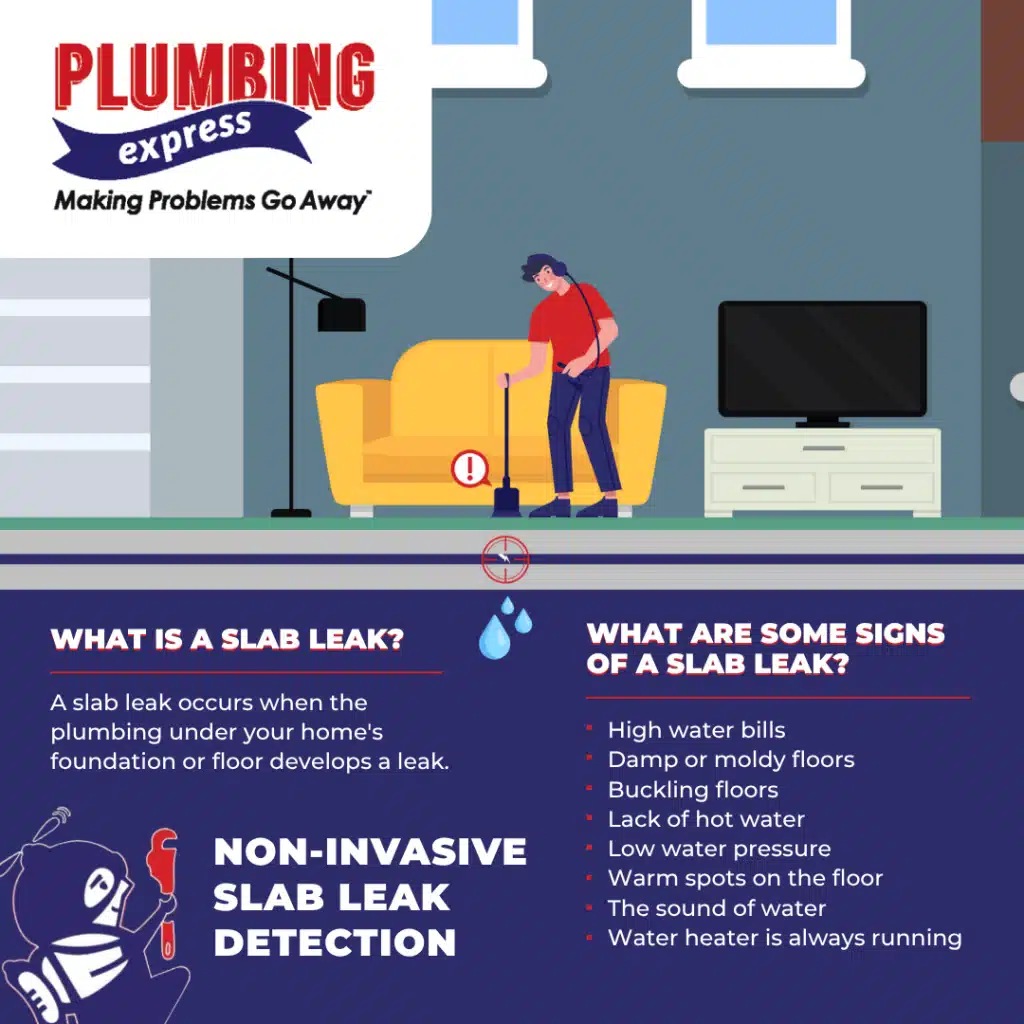
You hear water running when every faucet is off. Or one corner of the tile stays warm under your feet in a spot that should be cold. Those are the two slab leak signs Atlanta homeowners call us about most, and both can point to a leak under the concrete your house sits on. A slab leak is a leak in one of the water lines that run beneath your foundation. In much of Metro Atlanta, that means a line under the slab of a ranch, a split-level, or a home built without a basement. The tricky part is that the pipe is hidden, so the house tells you in ways that feel like something else at first.
Slab leaks are a big part of why Metro Atlanta homeowners call us. Here is what the early signs actually look like, what we do to confirm one, and how to tell whether a single leak needs a spot repair or is a sign to replace the whole system.
The slab leak signs Atlanta homeowners notice first
Most people do not think “slab leak.” They say “there’s a leak in the floor.” That is fine. The symptoms are what matter, and a few show up again and again.
- The leak you can hear. Water moving through a pipe when no fixture is on. It is faint. You catch it at night when the house is quiet. We had a homeowner with an older remodeled home and old copper under the slab who could hear the leak in her kitchen. It ran for months while she debated what to do.
- A warm spot on the floor. A hot water line leaking under the slab heats the concrete above it. You feel it through tile or wood in one patch that has no business being warm.
- A water bill that jumped for no reason. Same habits, same season, bigger number. A hidden leak runs day and night.
- A musty smell. Water weeping under the slab or inside a wall can start mold before you ever see a stain.
- Damp flooring or pooling near the foundation. A wet spot on carpet, buckling laminate, or standing water at the edge of the house outside.
- A tankless heater that will not shut off. If the unit thinks water is still moving, a leak downstream can be the reason. We took a call in the Powder Springs area for exactly that. A tankless that never turned off. We found the slab leak, confirmed a hot spot on the bathroom floor with a thermal camera, and repiped the house.
One caution, because we would rather be straight with you than sell you the wrong thing. Rust-colored water and low, uneven pressure are usually galvanized pipe problems, not slab leaks. Different pipe, different fix. Do not let those two symptoms push you toward assuming the worst.
A warm floor or a bill that does not make sense is worth getting checked soon.
Why homes on a slab are worth watching
Plenty of Atlanta-area homes sit on a slab instead of a crawlspace or basement. That puts a run of water line in the concrete, where you cannot see it and cannot easily reach it. The leak itself is rarely random. It usually traces back to the pipe material.
Copper develops pit marks that turn into pinhole leaks. Those start as a weep, then a drip, then a fine spray. Polybutylene corrodes from the inside out and looks fine on the outside right up until it fails. Certain earlier generations of PEX have a documented failure history, though most PEX performs well. If the failing line happens to be the one running under your slab, that is your slab leak. The build decade is a clue to which material you have. Homes from the 1980s and 1990s often have polybutylene or copper. Newer builds can still surprise you, because whole subdivisions sometimes went up with the same problem pipe.
Is a slab leak a big deal?
Yes, if it keeps running. A slow leak under the slab does not stay a plumbing problem. Water washes out the soil that supports your foundation. It feeds mold behind baseboards. It ruins flooring from underneath. The homeowner who waited months while the leak ran did not save anything. She paid for washed-out soil and bigger repairs and still made the same decision at the end. Acting early is almost always cheaper than acting late.
That said, do not panic. Most of the people who call us are annoyed, not in crisis. If the water is inside and actively damaging something, shut off the main and call. If it is a warm spot or a bill you cannot explain, you have time to get it looked at properly.
How Plumbing Express finds a slab leak
We do not start by breaking concrete. We start by proving there is a leak and figuring out where the water is going. Here is how our slab leak detection works.
First we check the water meter. The small indicator dial should sit still when nothing is running. If it creeps, water is moving somewhere. Next we isolate inside from outside. We shut the valve where the service line enters the house and read the meter again. If it stops, the leak is inside your plumbing. If it keeps spinning, the problem is out at the service line, which is a separate system from the pipes in your house.
When the leak is inside and the home is on a slab, we run a thermal scan to find temperature anomalies in the floor. That warm spot you felt shows up clearly to the camera. From there we can pressurize the drained system with air and listen acoustically, or use a gas tracer, a blend of hydrogen and nitrogen, with a detector passed over the slab to pinpoint the spot. We confirm the location before anyone touches the concrete. No exploratory jackhammering. One honest caveat: more than one leak can be present, and we will tell you if we find that.
Sometimes pinpointing the leak is not the best use of your money. If your pipe material is already failure-prone and has leaked before, it can make more sense to talk about a repipe first. If the rest of your system is in good shape, finding and fixing the one leak is usually the right call.
We confirm the location before anyone touches the concrete.
When a slab leak means a repipe
One leak in a healthy system is a repair. A pattern is a different story. The clearest sign you need a whole-house repipe is repeated leaks in walls, ceilings, or the slab on the same system. Here is the mechanic that surprises people. When you fix one leak, the static pressure in the line goes back up, and the next weak spot gives way. That is why repeat leaks on the same system are worth taking seriously.
As we like to put it, the first leak feels like bad luck. The third one is a pattern. If you have copper with recurring pinholes, polybutylene, or PEX from a bad generation, the leak under your slab is likely not the last one, and a repipe is worth considering. If your pipe is in good shape and this is the first leak, a spot repair is usually the sensible fix. We install a brand-new water distribution system, hot and cold lines run to every fixture as one connected system, tested before we call it done. We are not pulling all your old pipe out. Most of it gets abandoned in place. We only open what we need for access.
Another strong signal is your neighbors. Planned subdivisions share a build era, often the same original plumber, and the same pipes. When one house on the street has pipe trouble, others often run into it too. If your neighbors are getting repiped, it is worth finding out what pipe you have.
If a repipe does make sense, the cost depends on the size of your home and how the pipe runs through it. The only way to get your exact number is a free in-home visit, and the number on the estimate is the number on the invoice.
The only way to get your exact number is a free in-home visit.
Will insurance cover slab leak damage?
Homeowners insurance usually will not pay to replace pipe that failed from age, but it often helps with sudden water damage like the dry-out, drywall, and flooring. Every policy is different, so call your carrier, and see our guide on whether homeowners insurance covers a repipe in Georgia for more detail.
What to do if you suspect a slab leak in your home
Check your meter first. If the little dial is moving with everything off, you almost certainly have a leak. Note where the water is showing up, whether the floor is warm anywhere, and whether the smell has changed in any room. Then call us. We serve Metro Atlanta, from Marietta and Smyrna over to Duluth, Lawrenceville, Suwanee, and up through Woodstock, Canton, and the Cumming area. Slab homes in Cobb County and the surrounding cities are a big part of what we see, and neighboring homes tend to fail on similar timelines.
Plumbing Express is a licensed and insured Georgia plumbing contractor. Every crew works under our license and our liability coverage, and a licensed plumber leads every repipe. Ask and we will show you our license and certificate of insurance. When we do repipe a home, our own in-house drywall and paint technicians put the walls back, working from the same job scope as the pipe crew. Like a lot of our customers tell us, you cannot find where the work was done.
Get a slab leak checked before it costs you more
A warm floor or a bill that does not make sense is worth getting checked soon. We offer same-day in-home estimates most days across Metro Atlanta, and there is no pressure to move forward until you are ready. Call Plumbing Express at (404) 236-6535 or book online any hour to schedule your visit, and we will see you during service hours. Serving Metro Atlanta since 1989.